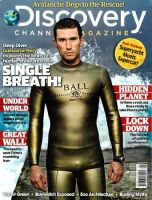
Deep Divers
Why would a sane man subject himself to the kind of pressure
that squeezes his lungs to the size of oranges?
To break the world depth record for diving without scuba gear, that''''''''s why.
Shortly after we went to press, diver Herbert Nitsch first broke
Nery''''''''s constant weight record by a single meter on April 4,
when he dove to 114 meters.
Next, on April 11, he dove to 120 meters deep - both dives were at
Deans Blue Hole in the Bahamas. (More info at www.verticalblue.net/news/)
======
◆Rescue Dogs
When caught in an avalanche, you have just minutes to live.
Thankfully, the powerful nose of a mountain rescue dog is there to search you out.
How do avalanches happen?
Every year millions of avalanches tumble down the sides of
mountain ranges around the world. The ingredients necessary
for avalanches are slopes over 28 degrees,
a snow load and a trigger.
Snow falls in different forms and creates layers in the snowpack
with differing densities.
If a softer layer becomes sandwiched between two, more dense,
layers a weakness is formed.
Imagine a stack of books on a slope with a layer of playing cards
between two of the books, eventually the load above the cards will
become too great and everything above the cards will slide down the hill.
Avalanches are the same.
The trigger for an avalanche can be natural or man made.
The load can become too much for the weak layer to bear whether
from increased snowfall, a blast from explosives, or the weight of a skier.
The collapse of the weak layer can start in a small isolated area
and move like a chain reaction over entire ridges.
When the mass of snow begins to slide, it starts as a
large slab then breaks up into a tumbling snow and air cloud accelerating
to speeds over 300km/h. Like most natural disasters,
avalanches are given size rankings based on their destructive potential.
Class 1 avalanches are small in nature and would be capable
of knocking over a skier and possibly burying them to the waist.
On the opposite end of the scale class 5 avalanches have massive destructive power
and could obliterate vast tracts of forest or entire towns.
======
◆Tokyo Underground
More than 30 metres below central Tokyo, massive machines are burrowing out an
innovative road system built to ease congestion, cut pollution and reduce fuel
consumption.
======
◆The Little Pilot
Famous across the world for his book The Little Prince, the French writer Antoine de
Saint-Exup¨|ry was also a daring, passionate and trailblazing pilot.
======
◆The Hidden Planet
According to the calculations of investigative astrophysicists, our solar system
contains too little mass. Could it be that there is another planet circling the sun?
======
◆The Penitentiary
When criminals were sentenced in Pennsylvania in the late 1800s, they knew they
wouldn''''''''t be physically punished. Instead, they''''''''d be forced to repent in one of the
world''''''''s most forbidding jails.
======
◆Saving the Wall
The Great Wall of China is decaying significantly, thanks in part to careless visitors.
But traditional Chinese caretakers are keeping the faith - and the structure - safe.
======
◆The Twitching Stick
Dowsers, diviners, water witches - all different names for specially gifted folk who
can detect water below ground. We ask Uncle Dick how he does it.
======
◆Green Buildings
Most people assume cars are the world''''''''s worst polluters.
Not so - buildings are the real villains.
We look at how architects are trying to make the next generation of structures and cities cleaner.